
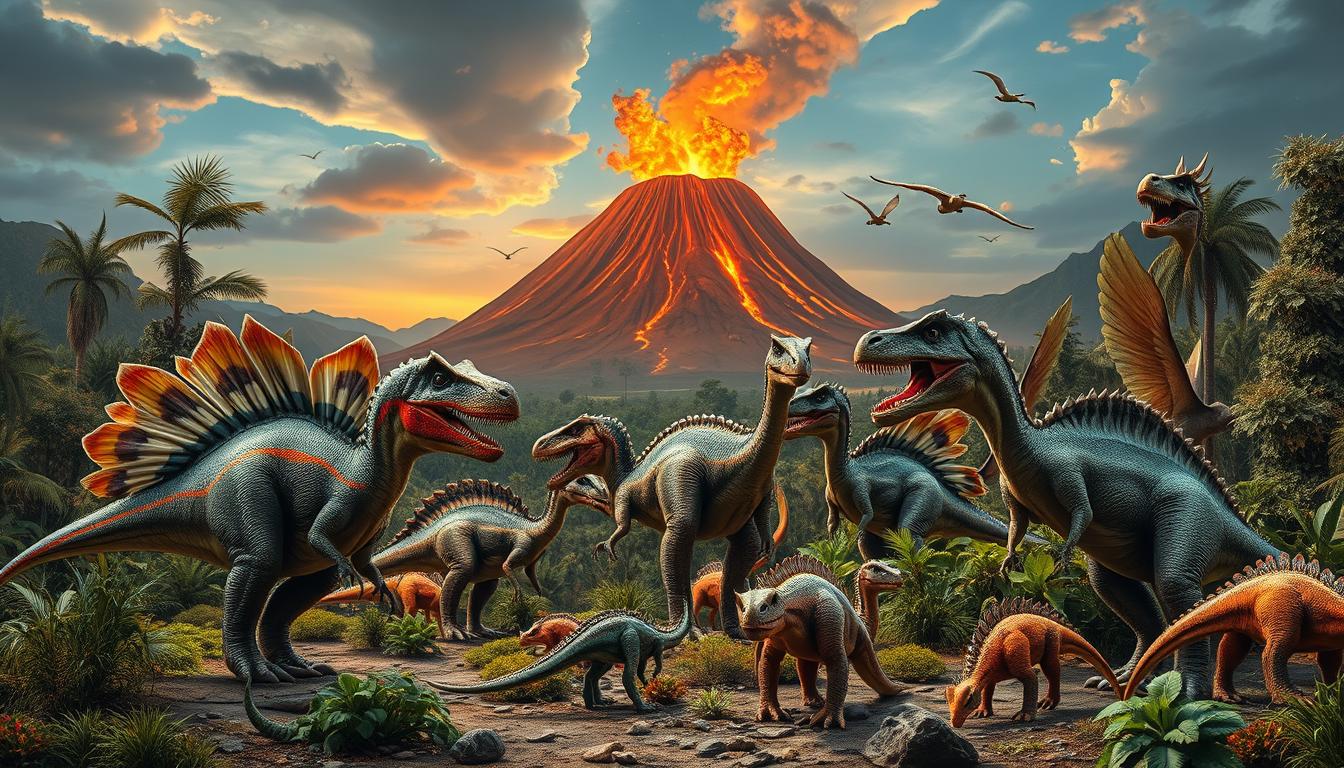
Get ready to have your mind blown! Dinosaurs, those mysterious giants from the past, have always fascinated us. But, what if everything you thought you knew about them is wrong? This article will reveal surprising facts about dinosaurs that will amaze you.
Dinosaurs have been a mystery for centuries. Their fossils give us clues about their lives. But, new discoveries in paleontology have changed what we thought we knew. Join us as we explore the world of dinosaurs, separate myths from facts, and learn about their incredible size and behavior.
The world of dinosaurs is more complex and interesting than you thought. From the fierce T. rex to the gentle plant-eaters, there’s so much to discover. So, buckle up and get ready to learn – this is a journey you won’t forget.
The Fascinating Era of Dinosaurs
The Mesozoic era, known as the “Age of Dinosaurs,” was a time of wonder. It lasted for millions of years and saw dinosaurs become the rulers of Earth. This era was split into three periods: Triassic, Jurassic, and Cretaceous. Each period showed how dinosaurs evolved and their changing worlds.
In the Triassic period, the first dinosaurs appeared. They evolved from their ancestors and adapted to their environments. The Jurassic period brought bigger dinosaurs, like long-necked sauropods and fierce carnivores.

The Cretaceous period saw more dinosaur species emerge. The Tyrannosaurus rex and flying pterosaurs became famous. This period also saw big changes in the climate and Earth’s shape, leading to the dinosaurs’ extinction.
The dinosaur timeline covers these three periods. It gives us a look at how these amazing animals evolved. It helps us understand the Mesozoic era and the prehistoric periods of their lives.
Myths vs. Facts: Debunking Common Misconceptions
The world of dinosaurs is filled with myths and misconceptions. These come from popular culture and old beliefs. But, thanks to paleontology research, we now know more about these ancient giants. Let’s look at some common myths and the scientific evidence that proves them wrong.
Many think dinosaurs were dumb and couldn’t talk or act smart. But, studies show that many dinosaurs had big brains and could communicate well. They used sounds, body language, and might have even had friends. Also, finding feathered dinosaurs has shown they weren’t all cold-blooded. Some dinosaurs, like birds today, were warm-blooded.
“Paleontology research has transformed our understanding of dinosaurs, challenging long-held beliefs and unveiling a more nuanced and compelling picture of these remarkable prehistoric animals.”
 But, fossils show dinosaurs were very different. There were giants like the Tyrannosaurus rex and gentle giants like the Brachiosaurus. The dinosaur world was full of variety.
As we learn more about dinosaurs through paleontology research and scientific evidence, we see them in a new light. By clearing up myths and focusing on facts, we can truly appreciate the dinosaur era’s complexity and wonder.
The Size of Dinosaurs: Larger Than Life
The size of dinosaurs has always fascinated us. They ranged from tiny, chicken-sized creatures to massive land animals. New discoveries keep changing how we see these giants, showing us just how big they were.
The Patagotitan mayorum, a titanosaur from the Late Cretaceous period, is one of the most impressive. It weighed up to 70 tons, making it even bigger than the largest living land animals. This largest dinosaur was taller than a two-story building and longer than a basketball court.
“The more we learn about these prehistoric giants, the more we realize just how awe-inspiring the dinosaur world truly was.”
The largest dinosaurs include the Tyrannosaurus rex and long-necked sauropods. Each was perfectly adapted to its environment, showing the incredible diversity of dinosaurs.

Our understanding of dinosaur sizes keeps growing. The size of these prehistoric giants still amazes us. From the tallest titans to the smallest dinos, their sizes capture our imagination.
Dinosaur Communication and Behavior
Exploring the world of dinosaurs, we find their social lives and ways of talking were quite interesting. New studies in paleobiology show us how these ancient animals interacted. They help us see beyond old myths.
It turns out, many dinosaurs were very social. They hunted together and took care of their young. Fossils and tracks tell us how they talked and signaled to each other. They might have used sounds, body language, and colors.

“The social lives of dinosaurs were far more intricate than we once believed. Their behaviors and communication methods were integral to their survival and evolution.”
By looking into dinosaur social habits and communication, scientists learn a lot. They understand the complex ecosystems of the past better. This knowledge not only amazes us but also helps us appreciate the natural world’s diversity.
The Dinosaurs’ Downfall: Understanding Extinction
The story of dinosaurs’ end has always fascinated people. Scientists and the public have many theories about their extinction. The most accepted reason is a huge event called the K-Pg extinction event.
A massive asteroid, about 6 miles wide, hit the Yucatán Peninsula in Mexico around 66 million years ago. This Chicxulub asteroid caused a chain of events that led to the dinosaur extinction. The impact threw a lot of debris and dust into the sky, blocking sunlight and changing the climate.
“The sudden cooling of the climate, combined with the loss of vegetation and food sources, likely proved too much for the dinosaurs to overcome, leading to their eventual demise.”
Volcanic eruptions also played a role in the mass extinction of dinosaurs. These eruptions in the Late Cretaceous period released greenhouse gases. This made the climate changes worse for the dinosaurs.
The K-Pg extinction event is a key moment in Earth’s history. It marked the end of dinosaurs and the start of the mammal era.
Dinosaur Fossils: A Peek into the Past
Dinosaur fossils give us a glimpse into the ancient world. Scientists use paleontology to study these fossils. They reveal what life was like millions of years ago.
Fossil formation is a natural wonder. Dinosaurs’ bones get covered in rock over time. This keeps their shape and tells us about their lives. Today, we can study these fossils in great detail thanks to new tools.
Finding dinosaur fossils is exciting but hard work. Paleontologists use special tools to find and dig up these fossils. They map the site and use advanced imaging to make sure the fossils are preserved.
“The discovery of a dinosaur fossil is like unearthing a piece of the past, a tangible connection to a world that existed long before our own.” – Dr. Emily Wilkins, renowned paleontologist
Keeping these fossils safe is key. Scientists use careful methods to protect them. This way, we can learn from them for years to come. It helps us understand how life evolved.
Paleontologists and new technology keep us fascinated by dinosaur fossils. Every new find adds to our knowledge of these amazing creatures. It makes us curious about the past and future.
Dinosaur Clones: The Science Behind Revival
The dream of bringing back dinosaurs has always fascinated us. Thanks to genetic engineering, this dream is now closer to reality. Scientists are working hard to find and rebuild dinosaur DNA from fossils. Their goal is to make these ancient giants alive again.
The journey to bring dinosaurs back is both complex and debated. It involves carefully taking and studying prehistoric DNA pieces. Then, scientists must put the genetic puzzle together. They also need to find a host species for the dinosaur embryo, raising big questions about ethics.
“The resurrection of the dinosaur is a tantalizing prospect, but one fraught with scientific and ethical hurdles.” – Dr. Emily Gonzalez, Paleogeneticist
Despite the obstacles, the study of de-extinction keeps drawing in scientists and the public. Research into dinosaur biology and evolution is ongoing. It could reveal new insights into the ancient world. As cloning technology advances, we might see dinosaurs roaming the earth once more.
Dinosaurs in Pop Culture: From Movies to Merchandise
Dinosaurs have always fascinated us in popular culture. They appear in movies and on toy shelves, becoming a big part of our fun. The Jurassic Park movies, for example, show us dinosaurs in a way that feels real. They mix amazing visuals with the excitement of discovery.
Dinosaurs also show up in TV shows like The Land Before Time. These shows teach us about the ancient world and spark our curiosity. And, people love buying prehistoric-themed products, from toys to collectibles, because of their love for dinosaurs.
“Dinosaurs have a timeless appeal that transcends generations. Their sheer size, power, and mystery captivate us, making them enduring icons of popular culture.”
As scientists learn more about dinosaurs, movies and TV shows are getting better at showing them. Creators work hard to make dinosaurs look real and teach us about them. This has made dinosaur entertainment even more exciting and educational for everyone.
Exploring Dinosaur Attractions Around the United States
The United States is a treasure trove for dinosaur enthusiasts. It’s home to top-notch dinosaur museums and fossil sites open to everyone. These places offer a unique chance to explore the ancient world.
The Smithsonian National Museum of Natural History in Washington, D.C., is a must-see. It has a vast collection of fossils and interactive exhibits. You can see massive T. rex skeletons and learn about new discoveries.
In the American West, the Carnegie Museum of Natural History in Pittsburgh, Pennsylvania, and the Field Museum in Chicago, Illinois, are also highlights. These museums display incredible fossils and create immersive experiences. They let you travel back in time and see the prehistoric world up close.