
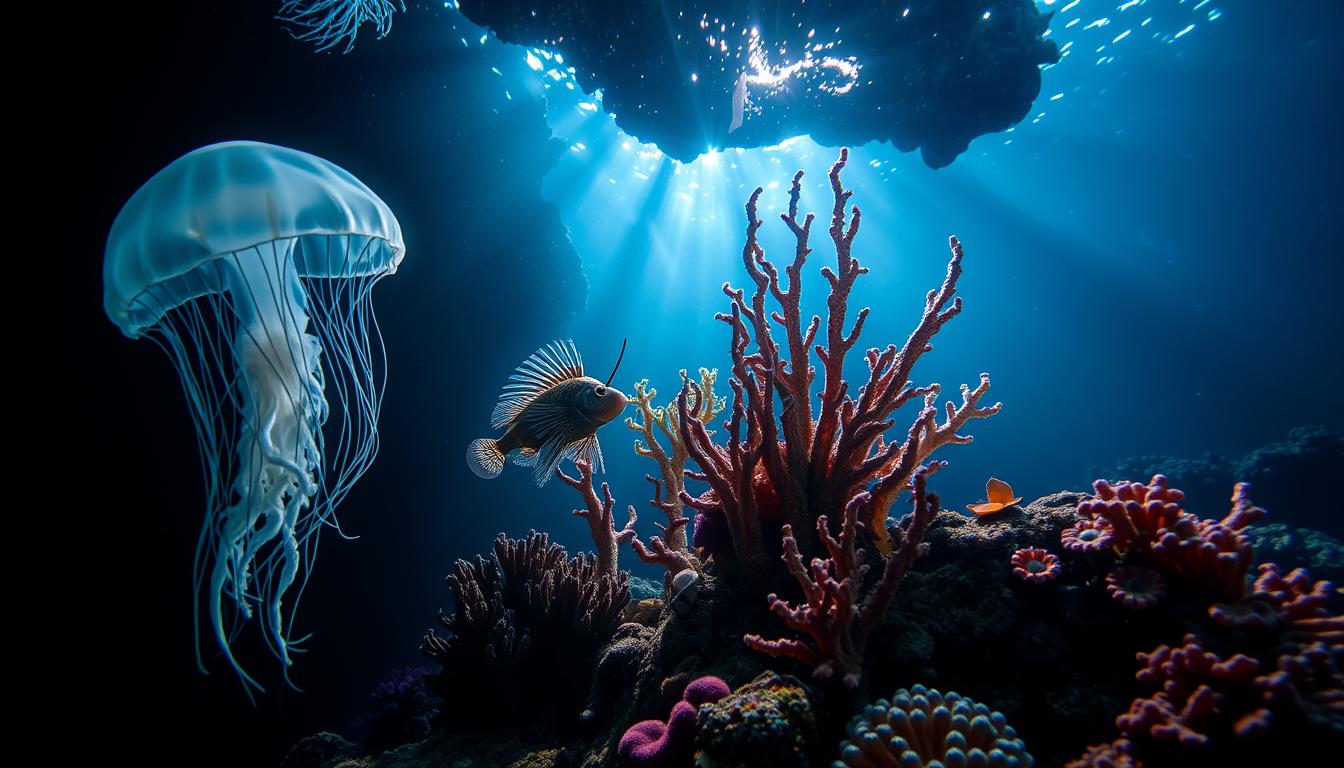
Step into the deep sea’s world, full of wonders hidden beneath the waves. Meet the creatures that live in the dark depths, where conditions are extreme. They light up the darkness with bioluminescence and have strange bodies that help them survive.
As we explore the deep, we find a world full of life. These deep-sea creatures have special ways to live in the dark and high pressure. They teach us about life’s limits and the natural world’s strength. Let’s discover the secrets of the marine life that lives in the deep sea.
Scientists use ocean exploration and research to uncover the deep’s secrets. They show us a world that’s both fascinating and important for our planet. Join us as we explore the deep sea’s creatures, their amazing adaptations, and their stunning bioluminescence.
The Enigmatic Deep Sea Ecosystem
Under the ocean’s surface, a hidden world is full of life. This world, known as the abyssal zone, is very different. It has extreme pressure, no light, and cold temperatures. Yet, it’s home to many different kinds of marine life.
The deep sea has hydrothermal vents, like underwater volcanoes. These vents release hot, mineral-rich water. This creates a special place for life to thrive in the deep ocean.
“The deep sea is the largest habitat on Earth, yet it remains one of the least explored and understood environments on our planet.”
In the deep sea, there’s no sunlight. But, creatures have found ways to survive. They use light to communicate and find food. This shows how life can adapt in amazing ways.
Exploring the deep sea is crucial. It helps us understand our planet better. The abyssal zone and its creatures hold secrets about life on Earth.
Adaptations of Deep Sea Creatures
The deep ocean is full of amazing adaptations. Creatures here have evolved unique ways to live in extreme conditions. Bioluminescence, or making light through chemical reactions, is a key feature. It helps them attract prey, communicate, and defend themselves in the dark.
Pressure resistance is also key for deep-sea creatures. The pressure at great depths is much higher than at the surface. But these organisms have special body structures to handle this pressure. Their tissues and organs keep working even under extreme pressure.

Energy conservation is vital for deep-sea creatures. Resources are scarce and unpredictable. Many have slow metabolisms and ways to save energy. This lets them survive for a long time without food.
Finally, deep-sea creatures have enhanced sensory adaptations. They live in total darkness, so they rely on sensitive organs to sense their surroundings. They have special eyes, chemical receptors, and appendages. These help them navigate and find prey in the dark.
“The deep ocean is a realm of extraordinary adaptations, where creatures have evolved remarkable strategies to thrive in the extreme conditions of their habitat.”
The adaptations of deep-sea creatures show the incredible resilience and ingenuity of life on Earth. These organisms have found innovative ways to deal with the deep-sea’s unique challenges. They thrive in one of the most extreme habitats on our planet.
Extraordinary Deep Sea Residents
The deep ocean is filled with strange creatures that live in the dark, cold depths. The anglerfish has a glowing lure on its head to catch prey. The giant squid, huge and mysterious, is a wonder of the deep.
The vampire squid can turn itself inside-out to hide. The viperfish has huge jaws and sharp teeth, making it a fierce hunter. The blobfish looks like a cartoon character, adding humor to the deep sea.
“The deep sea is the last great frontier on our planet, and it is teeming with extraordinary creatures that defy our imagination.”
These deep-sea creatures amaze us, showing us the ocean’s secrets. As we learn more, we’re constantly amazed by their diversity and how they’ve adapted to life in the deep.
Unique Feeding Habits
The deep sea is a tough place where finding food is hard. But, creatures living there have amazing ways to survive. They use filter feeding, bioluminescent lures, and scavenging to get by.
Many deep-sea animals, like giant isopods and some jellyfish, use filter feeding. They have special parts to catch tiny food particles from the water. This way, they save energy in a place where food is rare.
Some deep-sea hunters have bioluminescent lures to catch prey. These glowing parts attract fish and small creatures. Then, the hunter eats them quickly. This trick helps them survive in the dark depths.
Scavenging is also key for deep-sea animals. They look for dead or dying creatures on the seafloor. This way, they make sure to use every bit of food they can find.
Lastly, near hydrothermal vents, special communities exist. They use chemosynthesis to make food from chemicals from the vents. This lets them live without sunlight, which is rare in the deep sea.
“The deep sea is a realm of unimaginable feeding strategies, where organisms have evolved ingenious ways to survive and prosper in one of the most challenging environments on Earth.”

Communication Methods of Deep Sea Creatures
The deep ocean is dark and vast, yet it’s full of communication. Creatures here use bioluminescent signals to attract mates or find food. They also use chemical cues to navigate and mark their territory.
Sound waves and vibration detection play a big role in deep-sea communication. These creatures can feel the smallest movements and vibrations. This helps them find food and stay safe in the dark.
“The deep ocean is a realm where communication takes on a whole new form, a symphony of light, scent, and sound that echoes through the vast, dark expanse.”
Exploring the deep ocean reveals how creatures communicate and survive. Their communication methods amaze us and show how life can thrive in extreme conditions. Studying them teaches us about the ocean’s secrets and the creatures that live there.
The Role of Hydrothermal Vents
Deep in the ocean, a hidden world of life exists around hydrothermal vents. These underwater oases are formed by tectonic plates. They are key to the vent ecosystems that thrive in the deep sea.
Chemosynthetic bacteria live at the heart of these vent communities. They use the chemical energy from the vents to make food through chemosynthesis. This process doesn’t need sunlight, unlike photosynthesis. Instead, it uses the heat and minerals from the vents to create nutrients.
“These deep-sea oases are hotspots of biodiversity, supporting a wide array of specialized species that have evolved remarkable thermal adaptation to thrive in the extreme conditions surrounding the hydrothermal vents.”
The unique communities around the vents show how adaptable life can be. Creatures like giant tubeworms and chemosynthetic shrimp have evolved to live in these harsh conditions. They have found ways to use the abundant resources and survive the intense heat, pressure, and chemicals.

The importance of hydrothermal vents in supporting deep-sea life is huge. These features, found all over the seafloor, are centers of productivity and diversity. They show us the incredible resilience and creativity of the deep ocean’s inhabitants.
Human Exploration of the Deep Sea
The deep ocean has always fascinated us. It’s full of mysteries and unseen worlds. Thanks to new technology, we can now explore it better. We use submersibles and ROVs to uncover its secrets.
The Bathyscaphe Trieste was a big step in 1960. It reached 10,916 meters in the Mariana Trench. This achievement opened up more of the deep sea for us to explore.
“The deep ocean is the final frontier on our planet, and we’ve only begun to scratch the surface of what lies beneath the waves.”
Now, submersibles and ROVs help scientists study the deep sea. They’ve found hydrothermal vents and shipwrecks. These discoveries have changed how we see the ocean.
Exploring the deep sea is still a big adventure. There’s so much more to discover. The future of deep-sea exploration is full of promise and mystery.
Threats to Deep Ocean Life
Exploring the deep sea reveals alarming threats to these vast, unexplored realms. Deep-sea mining is a major concern. It extracts valuable minerals from the seafloor, harming the delicate ecosystems.
Ocean acidification from climate change is another big threat. It changes the pH levels, making it hard for deep-sea creatures to survive.
“The deep sea is a vast, complex, and largely unexplored realm, yet it is increasingly under threat from pollution and climate change. We must act now to protect these precious ecosystems before it’s too late.”
Pollution and climate change also affect deep-sea food webs. Warming surface waters and changing currents can disrupt nutrient supplies. This leaves many species struggling to survive.

The scientific community and policymakers must work together. They need to create strong conservation strategies and promote sustainable practices. This will help protect the deep ocean’s fragile environments. Only through teamwork can we preserve the deep sea’s wonders for future generations.
Amazing Reproduction Strategies
The deep sea is home to incredible creatures, each with unique ways of reproducing. They use bioluminescent courtship and brooding behaviors to overcome the deep’s challenges.
One standout feature is bioluminescence. Anglerfish, for example, light up the dark to find mates. Their glowing displays are a marvel, showing nature’s creativity.
But deep-sea mating is more than just lights. Some, like deep-sea octopuses, show incredible brooding. The female octopus guards her eggs for years, giving up food and risking her life for her young.
The journey of larval dispersal is also fascinating. Deep-sea creatures must dodge currents and predators to help their young grow. This shows their incredible resilience and adaptability.
“The deep sea is a realm of wonders, where life has evolved in the most unexpected and captivating ways.”
The Future of Deep Ocean Exploration
The future of exploring the deep sea is full of promise. New technologies, like advanced underwater vehicles and remote sensing, are changing how we map the seafloor. They help us find new marine species and uncover deep secrets.
Marine biotechnology is also a key area. Scientists are looking into deep-sea organisms for new compounds and enzymes. These could lead to big advances in medicine and renewable energy. Protecting these ecosystems is vital for future discoveries.
Understanding the ocean’s depths is crucial for deep-sea exploration. Projects like Seabed 2030 aim to map the entire seafloor. This will help us find new species and manage resources better, protecting the ocean.