The world is full of amazing sights that have always made us wonder. From the Northern Lights to the Bermuda Triangle, these sights amaze and intrigue us. But what makes them happen? Science is the answer, revealing the secrets behind these natural phenomena.
We’re going to look at 10 amazing natural phenomena and see how science explains them. We’ll explore everything from the beautiful auroras to the mysterious black holes. This will show us the wonders of the world and the power of science to understand our universe.
Unraveling the Northern Lights
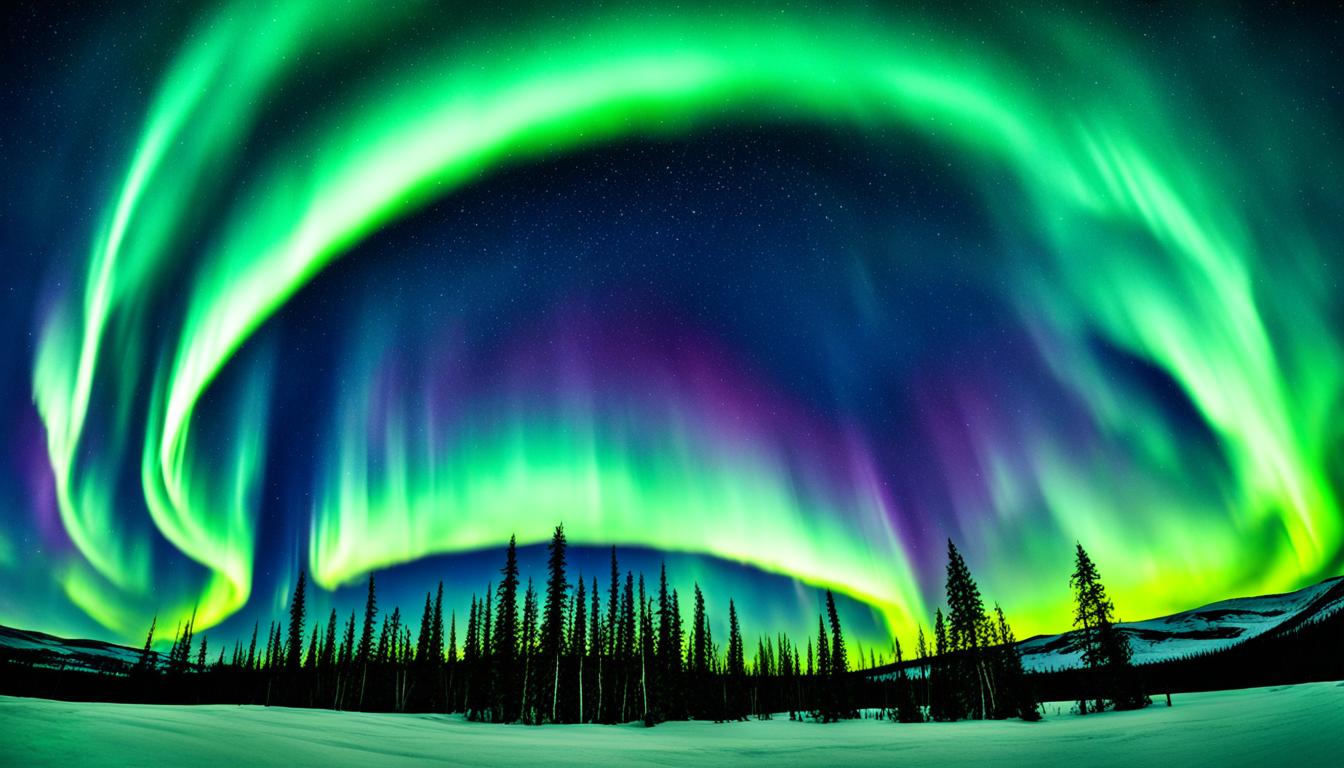
The Northern Lights, also known as the auroras, have amazed people for centuries. This stunning light show happens when the Earth’s magnetic field meets charged particles from the Sun. These particles hit the Earth’s atmosphere, causing it to glow with colors across the night sky.
The Science Behind the Auroras
The science of the auroras shows how our planet and the Sun interact. The Sun sends out charged particles called the solar wind into space. When these particles reach Earth, they follow the magnetic field to the poles. There, they bump into gas molecules, making the Northern Lights shine in colors like green, pink, purple, and blue.
The Northern Lights change in intensity and pattern based on several things. Solar activity and the strength of the Earth’s magnetic field play big roles. When the Sun has more activity, like a solar flare, the Earth gets hit with more charged particles. This makes the auroras brighter and more lively.
The Bermuda Triangle Enigma
The Bermuda Triangle is a mysterious area in the western North Atlantic Ocean. It has always caught people’s attention with its unexplained disappearances of ships and planes. Scientists have come up with different theories to explain these mysteries.
Theories and Explanations
One theory is that compass anomalies cause the strange happenings in the Bermuda Triangle. The area’s unique location can mess with navigation tools, leading to confusion and accidents. Another idea is that methane gas bubbles in the seafloor might make ships sink suddenly.
Extreme weather like sudden storms, hurricanes, and waterspouts is also thought to play a role. These weather events can be very dangerous for ships and planes, leading to tragic events.
Despite the mystery, scientists keep studying the Bermuda Triangle. They aim to find logical explanations for the strange events. By understanding the area’s natural phenomena, they hope to shed light on the long-standing mysteries.
Mirage: An Optical Illusion
Have you ever seen what looks like a shimmering pool of water in the desert? This is called a mirage, a cool optical illusion caused by light bending. It happens when light changes direction as it goes through air with different temperatures. This makes it seem like things are there that aren’t really there.
The science behind mirages shows how light and the atmosphere work together. When the desert gets hot, the air close to the ground gets warmer and less dense than the air above. This makes the light bend, creating the mirage effect. It looks like the light is reflecting off a surface, making people think they see water or other objects far away.

Mirages aren’t just for deserts; they can happen in other places too, like over big lakes or on hot highways. This trick of the eye shows how light, temperature, and the environment can play together. It’s a cool way to see how our senses can be tricked by nature.
The Science of Rainbows
Rainbows are a stunning natural wonder that happen when sunlight meets water droplets in the air. They are made by the complex process of light bending. When sunlight goes through water droplets, it bends at different angles. This bending makes the colors we see in a rainbow.
Dispersion of Light
When sunlight goes into a water droplet, it changes direction because light travels faster in air than in water. This bending separates the white sunlight into its colors, each with a specific wavelength. The shorter wavelengths, like blue and violet, bend more than the longer ones, like red and orange.
Conditions for Rainbow Formation
To see a rainbow, the sun must be behind you, and the water droplets must be in the right spot. They need to reflect and bend the sunlight. Also, the water droplets should be about 0.5 to 1.0 millimeters wide for the colors to be clear. These conditions come together to create the beautiful rainbow we see in the sky.
Bioluminescence: Nature’s Glow
The natural world is full of wonders, and bioluminescence is one of the most captivating. This process lets living things make and send out light. It shows how amazing marine life can be. From glowing fireflies to deep-sea creatures, bioluminescence is a cool way to see the complex chemical reactions in these organisms.
Chemical Reactions in Living Organisms
Bioluminescence happens because of complex chemical reactions. These reactions use special enzymes and substances. They help attract prey, keep predators away, or talk to other organisms. This results in the glow that amazes us.
By studying bioluminescence, we learn how living things have adapted to their environments. This ranges from shallow ocean waters to the deep sea. It helps us understand how life thrives in different places.
Looking into bioluminescence also helps us in fields like biology and medicine. As we learn more about this glow-in-the-dark phenomenon, we find new ways to improve science and technology. This helps us better understand life on Earth and how everything is connected.
The Doppler Effect
The Doppler effect is a fascinating scientific phenomenon that affects us every day. It happens when a wave source, like sound or light, moves relative to an observer. When the source comes closer, the wave’s frequency seems to go up. When it moves away, the frequency seems to drop.
This change in frequency has many uses in science. In the world of sound waves, it helps us detect the speed and direction of emergency vehicles. This lets us react quickly and safely. It’s also used in light waves to study the motion and makeup of stars and planets by looking at frequency shifts in their light.
Applications in Everyday Life
The Doppler effect isn’t just for scientists; it’s part of our daily lives. Radar guns use it to measure how fast cars are going. It’s also in medical imaging, like ultrasound, to track blood flow and find health problems.
From spotting emergency vehicles to exploring space, the Doppler effect and its scientific applications amaze and teach us. By using this phenomenon, we gain new insights and solutions. This helps us live better and advance science.
Science Behind Gravitational Waves
Gravitational waves are fascinating phenomena that have caught the attention of scientists and the public. They were predicted by Albert Einstein’s theory of general relativity. This theory changed how we see the universe. These waves come from massive objects like colliding black holes or neutron stars.
The study of gravitational waves has given us new insights into space, time, and cosmic events. By studying these disturbances, scientists learn more about the universe’s laws. These laws affect everything from tiny particles to huge stars.

Finding gravitational waves shows the power of scientific discovery. They confirm Einstein’s theory of general relativity. This has deepened our understanding of the universe and its laws.
The study of gravitational waves is still uncovering new mysteries. Researchers are exploring the cosmos and expanding our knowledge. This will likely lead to even more discoveries in the future.
The Greenhouse Effect
The greenhouse effect is a natural process that keeps our planet warm and supports life. It happens when gases in the atmosphere trap heat from the sun. These gases, called greenhouse gases, stop the heat from escaping back into space.
This process is vital for a warm and habitable Earth. But, human actions have made the greenhouse effect worse. This has led to global warming and climate change.
Causes and Consequences
The main causes of the stronger greenhouse effect are burning fossil fuels and cutting down forests. These actions release a lot of greenhouse gases like carbon dioxide and methane. As a result, the Earth’s temperature keeps going up.
This has caused glaciers to melt, sea levels to rise, and weather events to get more severe. It also changes ecosystems and how we grow food.
The effects of the greenhouse effect and climate change are huge. They affect the environment, our health, and the economy. It’s important to understand the science behind it to find ways to deal with these issues.
We can reduce greenhouse gas emissions by using more renewable energy and adopting sustainable practices. This will help protect our planet for the future.
Quantum Entanglement
In the world of quantum mechanics, a strange thing called quantum entanglement challenges our old ideas about the universe. It’s when tiny particles get linked together in a way that’s hard to understand. These particles can be far apart, but what happens to one can instantly change the other.
This strange effect, which Albert Einstein called “spooky action at a distance,” changes how we see quantum mechanics and reality. It helps us understand the odd ways tiny particles work. It also could lead to big changes in technology, like better computers and secret messaging.
Unraveling the Quantum Enigma
Quantum mechanics is all about the tiny things we can’t see. Quantum entanglement shows us how these tiny things interact in strange ways. By studying this, scientists are learning more about the universe and finding new tech possibilities.
Looking into quantum mechanics, we see how entanglement could change things. It could make communication super secure and help create powerful computers. This study of the tiny things in our world keeps inspiring new ideas and challenges our understanding.
The Black Hole Phenomenon
Black holes are fascinating and mysterious cosmic objects. They have a huge gravitational pull, even stronger than light can escape. Einstein’s theory of general relativity explains how massive objects warp spacetime.
Exploring the Cosmic Mysteries
Astrophysicists and cosmologists are studying black holes to understand them better. They want to know how these objects form and evolve. They also want to see their role in the universe.
By learning about black holes, scientists hope to solve the mysteries of spacetime. They aim to understand the extreme regions of the universe better.
Dark Matter: The Missing Piece
In our universe, there’s a mysterious substance called dark matter. It’s invisible and makes up a big part of the cosmos. Scientists know it’s there because of its gravity effects on visible matter and the universe’s structure. But figuring out what it is has been hard.
The search for dark matter has grabbed the attention of scientists. Finding out about it could change how we see our universe. Many theories have been suggested, but solving this unseen matter mystery is still a big challenge. The study of dark matter is exciting, offering new knowledge and changing how we see the cosmos.
Researchers worldwide are using new tech and ideas to learn more about dark matter. They’re looking at the sky with advanced tools and creating new theories. The goal is to understand dark matter and its effect on our universe. This quest is a big part of scientific discovery and could be very exciting.